

Market volatility often reflects a confluence of factors, and recent swings across major indices are no different. Events including leadership changes at Nvidia and Anthropic's initial public offering (IPO) contributed to declines that pushed the S&P 500 and Dow Jones Industrial Average into correction territory, while the Nasdaq briefly erased its year-to-date gains.
Subsequently, markets have partially recovered, particularly following the reinstatement of Jensen Huang as Nvidia's CEO, reportedly with White House involvement. This episode illustrates how rapidly markets can respond to new information and underscores the importance of maintaining a long-term perspective. The central question remains whether the hundreds of billions of dollars flowing into AI infrastructure will ultimately generate sufficient returns. Notably, even amid the market turbulence, a mathematician at Anthropic used AI to develop a proof of the Riemann Hypothesis, a 167-year-old mathematical problem. While this breakthrough may not have an immediate impact on everyday investors, its significance for the broader trajectory of AI is considerable.
Corrections are a normal and expected part of market cycles
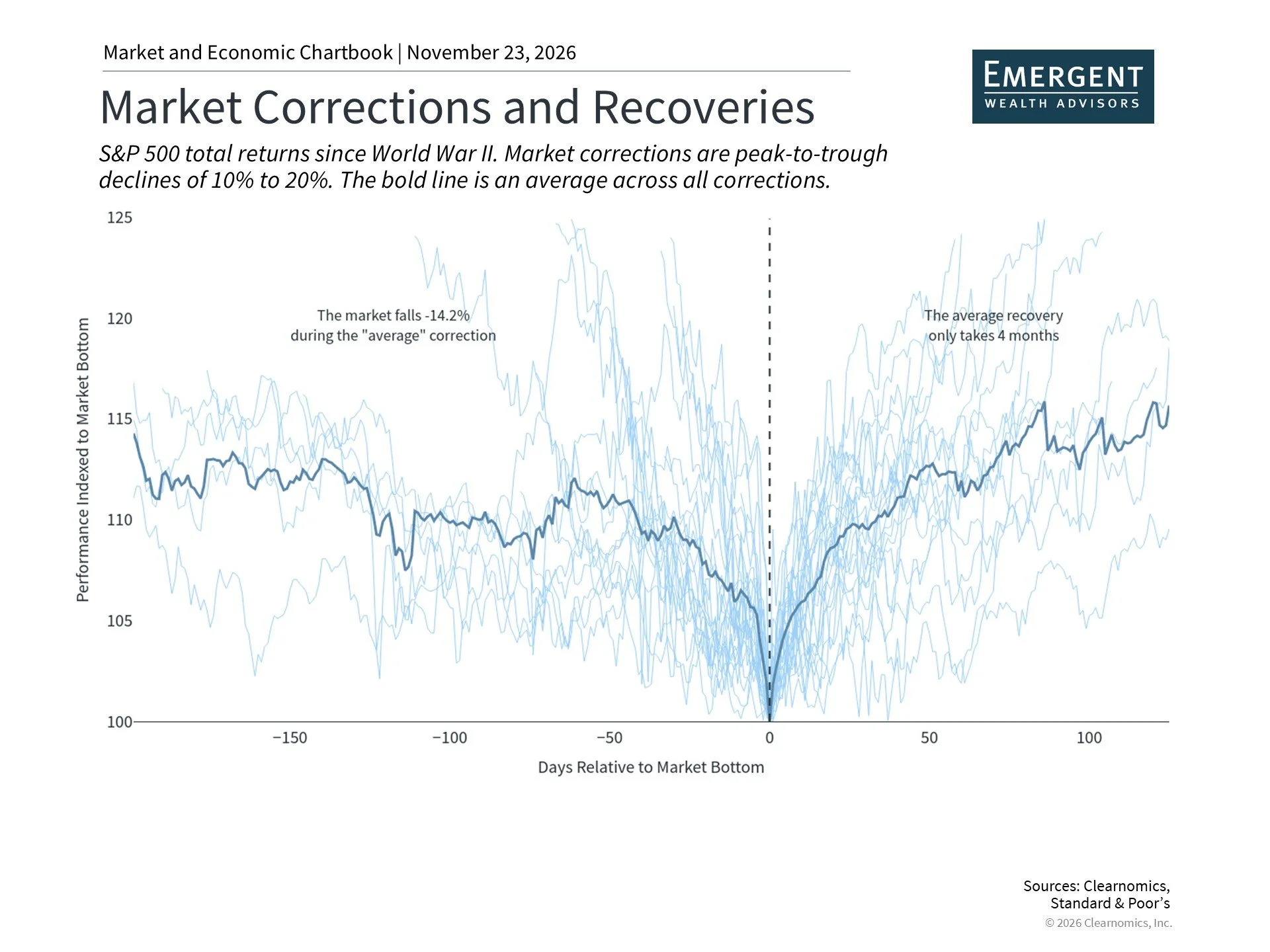
At their lowest point, the S&P 500 and Dow fell into correction territory, defined as a decline of between 10% and 20% from recent peaks, while the Nasdaq came close to bear market levels, defined as a fall of 20% or more. These declines were concentrated in technology stocks, particularly semiconductor companies tied to AI hardware. Between October 6 and November 20, Nvidia shares declined about 48%, contributing to pullbacks of roughly 18% for the Nasdaq and 12% for the S&P 500.
Technology stocks are inherently more volatile, and the Nasdaq has experienced several notable swings over the past year alone. From early June to the end of July, the Nasdaq declined 9.8% from its peak due to many of the same AI-related concerns present today. This was followed by a rebound of 13.0% to a new all-time high in early October. From October 2025 to the beginning of the Iran war in March, the Nasdaq declined 12.6%, before rebounding into the summer. Since World War II, the S&P 500 has declined about 14% on average during corrections and has recovered within roughly four months.
Strong fundamentals do not prevent corrections, and past recoveries are not a guarantee of future results. However, a healthy economic foundation has historically supported portfolios over the long run, as demonstrated by examples such as the market's rebound following the "Liberation Day" tariffs.
Innovation has historically been a long-term driver of market growth
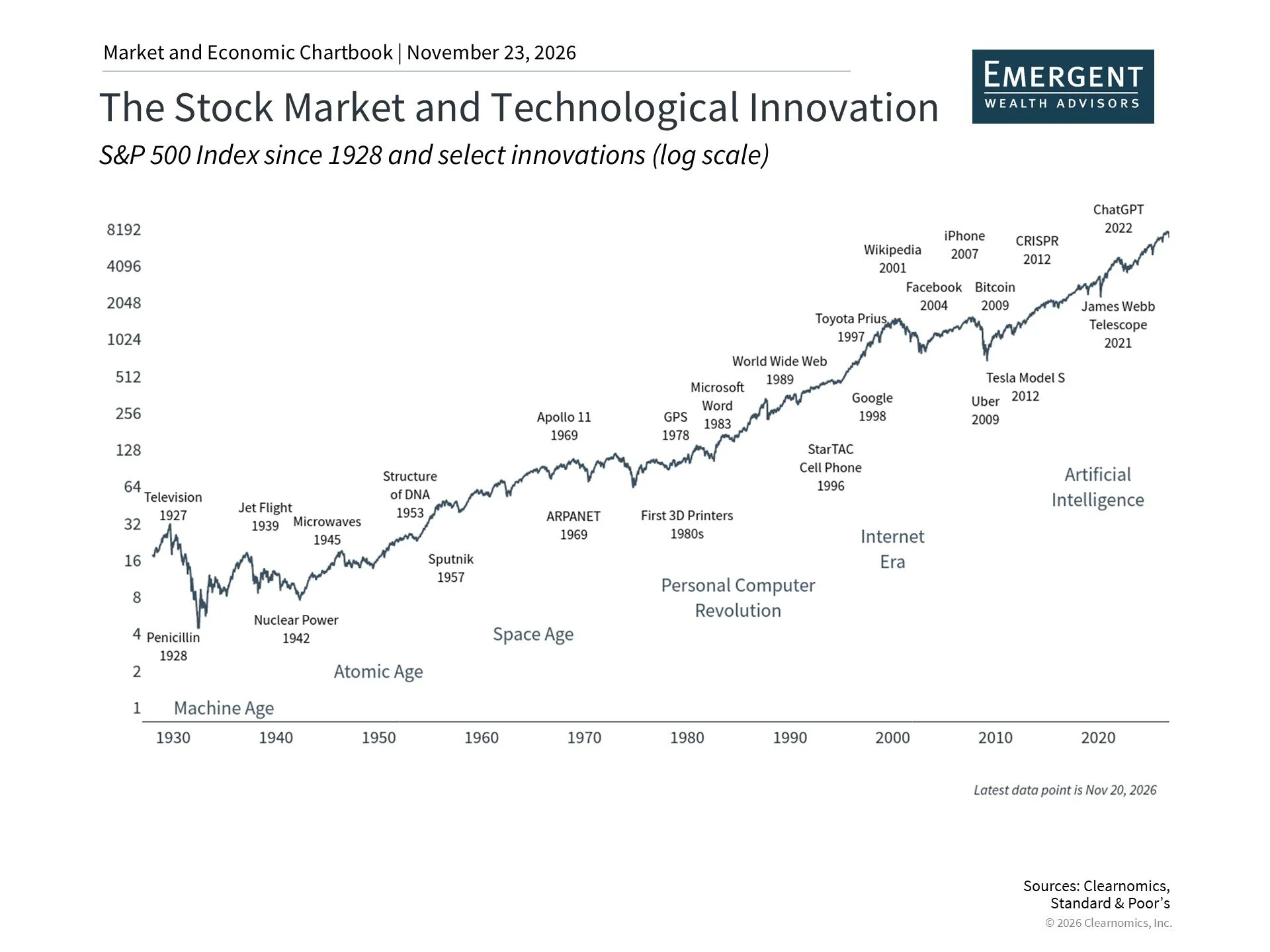
Each wave of technological innovation over the past century has been accompanied by both excitement and uncertainty, yet the stock market has risen steadily as new technologies were adopted by the broader economy. The dot-com era offers a useful parallel. Telecommunications companies built extensive fiber optic networks in anticipation of internet growth, and while some overextended firms failed, the infrastructure they created became the foundation for streaming, cloud computing, and the connected economy that underpins many industries today.
Whether today's AI investments will follow a similar path remains the open question at the heart of current market uncertainty. Anthropic's recent IPO also signals that the AI market is maturing. As companies list on exchanges such as the Nasdaq, they become eligible for inclusion in broad market indices like the S&P 500 over time, allowing diversified investors to gain natural exposure as these companies grow.
Elevated volatility has historically preceded healthy forward returns
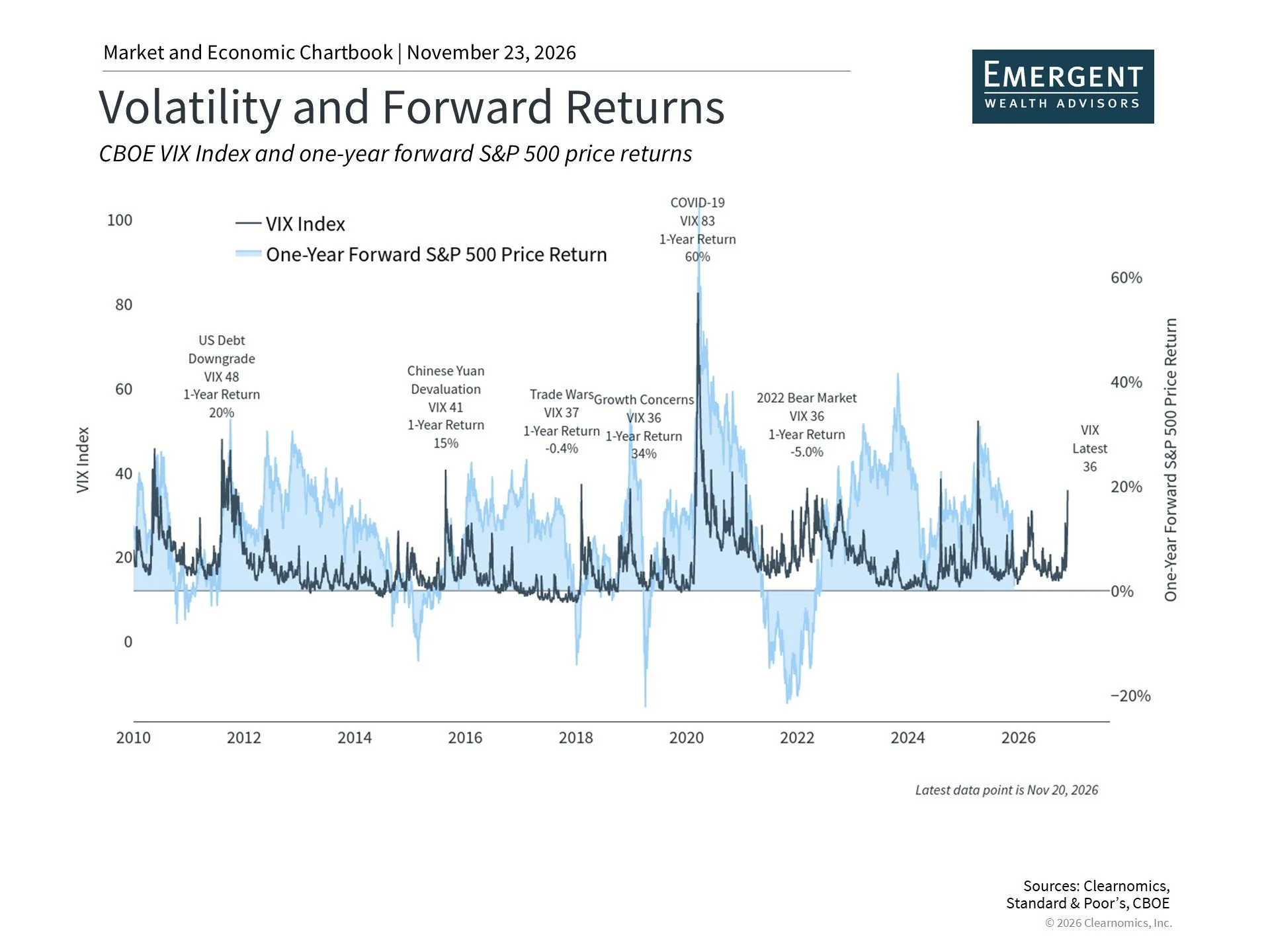
Periods of market volatility can feel unsettling, but they also present opportunities for disciplined, long-term investors. As the accompanying chart shows, historically high readings of the CBOE Volatility Index (VIX) have tended to correspond with healthy market returns over the following year. This pattern has been observed across many episodes in recent years, even when uncertainty prompted some investors to seek the safety of cash.
Volatility can also create financial planning opportunities. With year-end approaching, tax-loss harvesting allows investors with taxable accounts to realize losses that can offset gains elsewhere, subject to rules such as the wash-sale rule, which prevents investors from acquiring the same or a "substantially identical" security within 30 days before or after the sale. Strategies like these can add value regardless of near-term market direction and are best considered within the context of a long-term financial plan.
The bottom line? AI-related volatility has created short-term uncertainty, but corrections and recoveries are a normal part of investing. The long-term potential of AI, already visible in recent mathematical breakthroughs, reinforces the value of a patient and balanced portfolio aligned with long-term financial goals.