

August reinforced a familiar lesson: strong markets do not require ideal conditions. Despite persistent uncertainty around oil prices, Federal Reserve policy, newly enacted tariffs affecting global trade, and interest rates at their highest levels in decades, a number of positive factors pushed broad market indices higher.
For investors, the central message is that short-term concerns are a normal feature of financial markets. History suggests that portfolios constructed around long-term objectives offer the best chance of achieving financial success, rather than attempting to navigate every near-term challenge. With that in mind, here is a look at what shaped markets in August and what investors should consider going forward.
Key Market and Economic Highlights for August
• The S&P 500, Nasdaq, and Dow Jones Industrial Average rose 2.6%, 3.9%, and 1.3%, respectively, in August. Year-to-date, they have gained 12.3%, 13.5%, and 10.7%, respectively.
• Volatility, as measured by the CBOE VIX index, dropped below the long-term average, ending the month at 16 after climbing as high as 21 the previous month.
• International developed markets returned 1.8% based on the MSCI EAFE Index in U.S. dollar terms, while emerging markets returned 3.2% based on the MSCI EM Index.
• The 30-year Treasury yield reached its highest level since 2007, closing the month at 5.24%. The 10-year Treasury yield ended the month at 4.75%. The Bloomberg U.S. Aggregate Bond Index returned 0.4% for the month.
• Oil prices hovered in a range in August after climbing the previous month. Brent crude closed the month at $90.68 per barrel and WTI near $86.27 per barrel.
• The U.S. Dollar Index fell to 99.43 at the end of August. Gold ended the month at $4,437.38 per ounce while silver rose to $66.58 per ounce.
• The revision to second quarter GDP remained unchanged at an annual rate of 1.5%.
• The July jobs report missed expectations with a decline of -23,000 in payrolls compared to a forecasted gain of 80,000. Unemployment fell slightly to 4.1%.
Long-term yields are near multi-decade highs
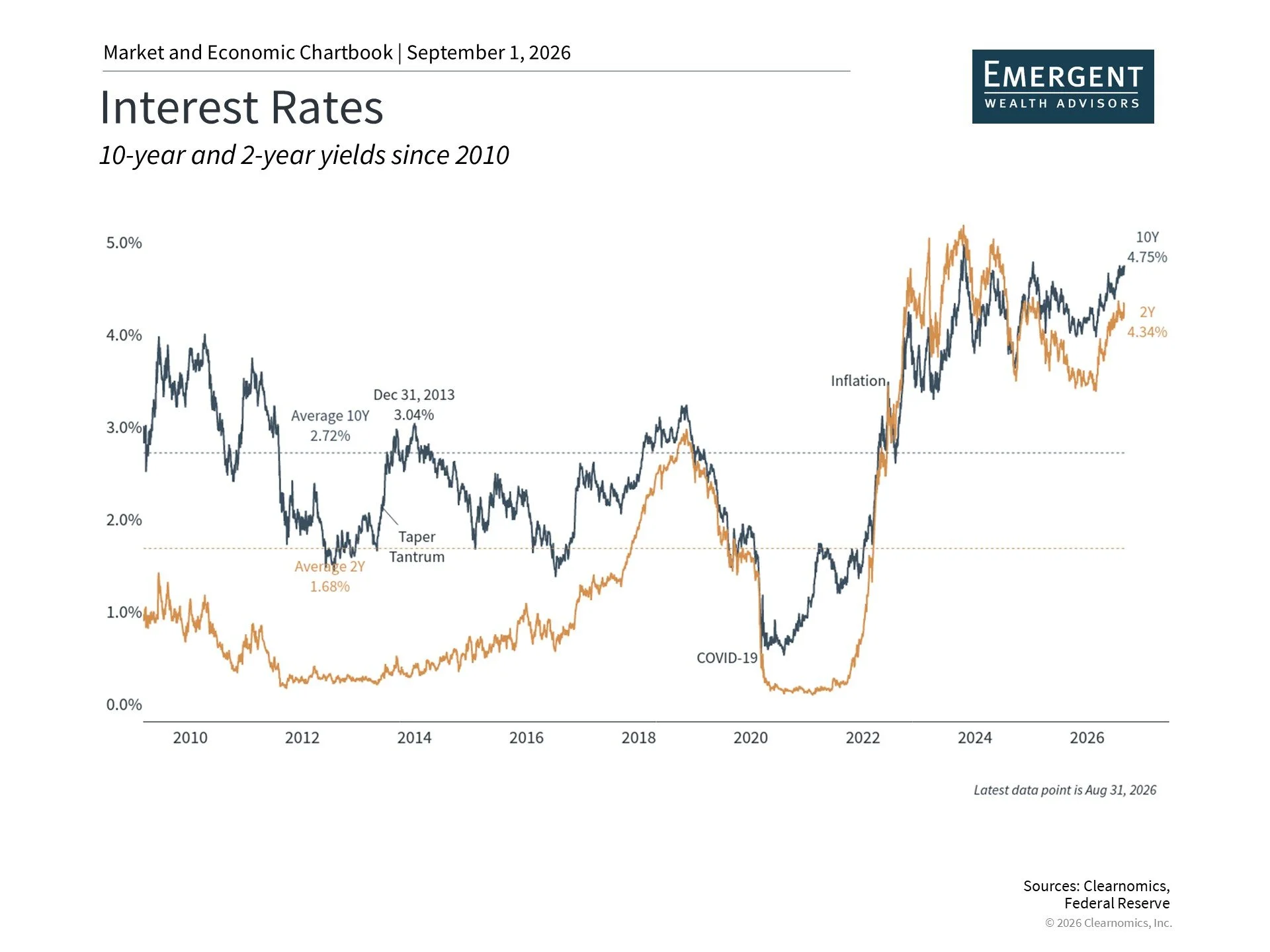
One of the defining characteristics of the current investment environment is that interest rates have stayed higher than many anticipated. The 30-year Treasury yield briefly exceeded 5.3% in August, a level not seen in nearly 20 years. The 10-year Treasury yield, hovering around 4.8%, is also close to its recent peak.
While interest rates can appear to be a technical subject, they both influence and reflect the broader state of the economy.
Higher rates are often viewed as a headwind for markets, but the underlying reason for rising rates matters considerably. Although inflation drove rates higher in recent years, more recent increases have been tied to improvements in "real yields." Put differently, inflation-adjusted yields are higher, which reflects an economy that remains fundamentally healthy, supported in particular by strong corporate earnings. Over the long run, this represents a constructive signal for overall market health, which is why interest rates and stock prices are both near elevated levels simultaneously.
Higher rates also create income opportunities for long-term investors through their bond holdings. At the same time, rising rates place downward pressure on the prices of existing bonds, which has kept major bond indices such as the Bloomberg U.S. Aggregate Bond Index roughly flat this year. It is therefore important to consider rising rates within the context of a well-balanced portfolio and in relation to individual financial goals.
Inflation nonetheless remains above levels that consumers and policymakers would prefer. The headline Personal Consumption Expenditures Price Index showed that inflation stood at 3.7% year-over-year in July, while core PCE rose 3.3%, both well above the Fed’s 2% target.
At the Fed’s annual Jackson Hole symposium in late August, Fed Chair Kevin Warsh signaled that a rate hike could arrive sooner. As a result, markets are now pricing in at least one rate hike this year, and possibly two by early next year.
Corporate earnings are delivering broad-based growth
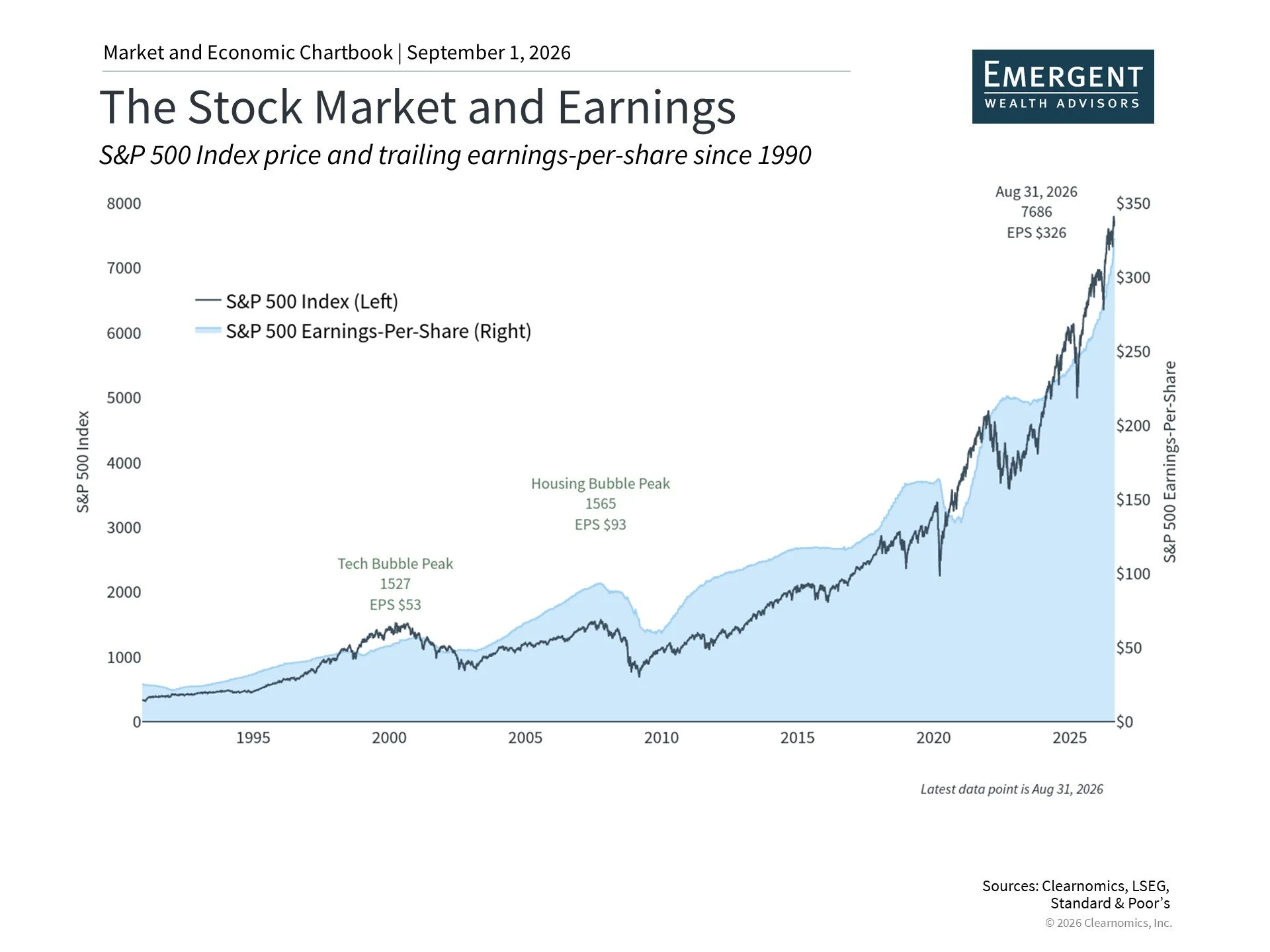
The S&P 500 reached new all-time highs in August, propelled largely by robust corporate earnings. Second quarter results came in well ahead of expectations across a broad range of sectors, and consensus estimates now project S&P 500 earnings to reach $349 per share by year-end. Those same forecasts call for earnings-per-share growth of 15% in each of the next two years, above the historical average of 7%.
While these projections are subject to change, they reflect growth supported by AI infrastructure investment, higher oil prices, and healthy expansion across sectors. Ten of the eleven S&P 500 sectors reported year-over-year earnings growth, with nine of those posting double-digit percentage gains. This breadth of earnings growth indicates that the broader economy, not just a small number of large companies, is contributing meaningfully to corporate profitability.
Strong corporate earnings are one reason that broad stock market valuations have remained relatively stable over the past year. The S&P 500 price-to-earnings ratio has remained around 20x, which is above the historical average of 16x but represents an improvement from recent peaks. While valuations are not reliable short-term predictors, they serve as important guides for long-term asset allocation. In an environment of elevated valuations, maintaining balance across sectors, asset classes, and geographies remains a sound approach.
Trade tensions are still a source of uncertainty
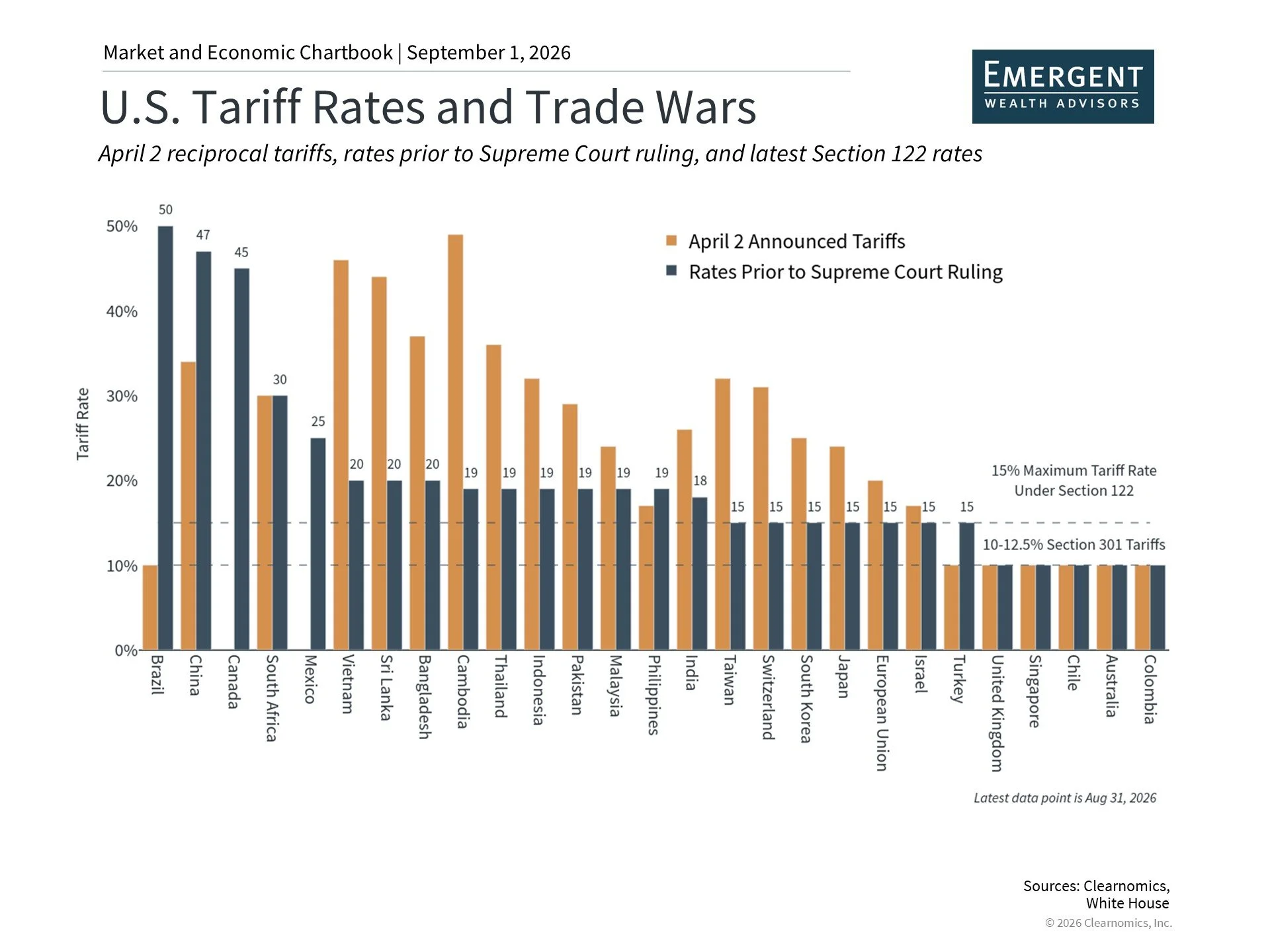
Trade policy returned to the forefront in August as tensions with key trading partners, including Canada, escalated. Following the Supreme Court’s February ruling that last year’s "Liberation Day" tariffs were illegal, new tariffs were put in place under alternative legal frameworks, including Section 301 of the Trade Act of 1974. Those tariffs have since expired, and additional ones have been implemented under other trade laws, each governed by its own set of rules. Concurrently, the government has begun refunding the original "reciprocal tariffs" to businesses, with $129 billion already accepted for processing by U.S. Customs and Border Protection.
As has been the case since early last year, the most severe outcomes that many investors and economists anticipated have not materialized. This is largely because companies have adapted their supply chains, revised pricing strategies, and managed costs in response to these tariffs, which has limited the inflationary impact of higher intermediate prices. Even so, tariffs are likely to remain a source of uncertainty for global markets in the years ahead.
The bottom line? August demonstrated the importance of staying balanced and not overreacting to headlines. Despite periods of volatility, strong corporate earnings and attractive bond yields continue to support long-term portfolios.