

July proved to be a difficult month for financial markets, with major indices finishing slightly in the red. That said, this should be viewed in the context of solid year-to-date gains and a broad market that remains near its all-time high. A variety of forces shaped daily market movements during the month, among them fresh concerns about AI spending, Treasury yields pushing toward multi-year peaks, rising oil prices following a breakdown in Middle East ceasefire negotiations, and the Federal Reserve opting to hold rates steady.
Many of these developments reflect durable longer-term themes that may continue to generate volatility in the months ahead. At the same time, these same forces have helped power markets higher this year, underscoring the value of portfolio balance and a long-term perspective. What takeaways can investors draw from July as they look ahead to the remainder of the year?
Key Market and Economic Drivers in July
• The S&P 500 and Nasdaq declined -0.1% and -3.2%, respectively, while the Dow Jones Industrial Average rose 0.3% in July.
• Volatility jumped in the middle of the month with the VIX index climbing as high as 21 before settling back toward 16.
• International developed markets returned 1.9% based on the MSCI EAFE Index in U.S. dollar terms, while emerging markets fell -3.3% based on the MSCI EM Index.
• The 30-year Treasury yield surged to a 19-year high to close around 5.28% and the 10-year Treasury yield ended the month at a peak of 4.74%. The Bloomberg U.S. Aggregate Index fell -1.3%.
• Oil prices rose with Brent crude climbing above $100 before closing at $90 per barrel and WTI at $85 per barrel.
• The U.S. Dollar Index (DXY) fell just under 100 while the Japanese Yen depreciated significantly, closing around 157. Gold ended the month approximately unchanged at about $4,050 per ounce.
• Second quarter real GDP growth increased at an annual rate of 1.5%, down from the 2.1% growth recorded in the first quarter of the year.
• At the July FOMC meeting, the Federal Reserve decided to keep rates unchanged at 3.50%-3.75% in a 9-3 vote.
AI investment spending drives mixed outcomes across the technology sector
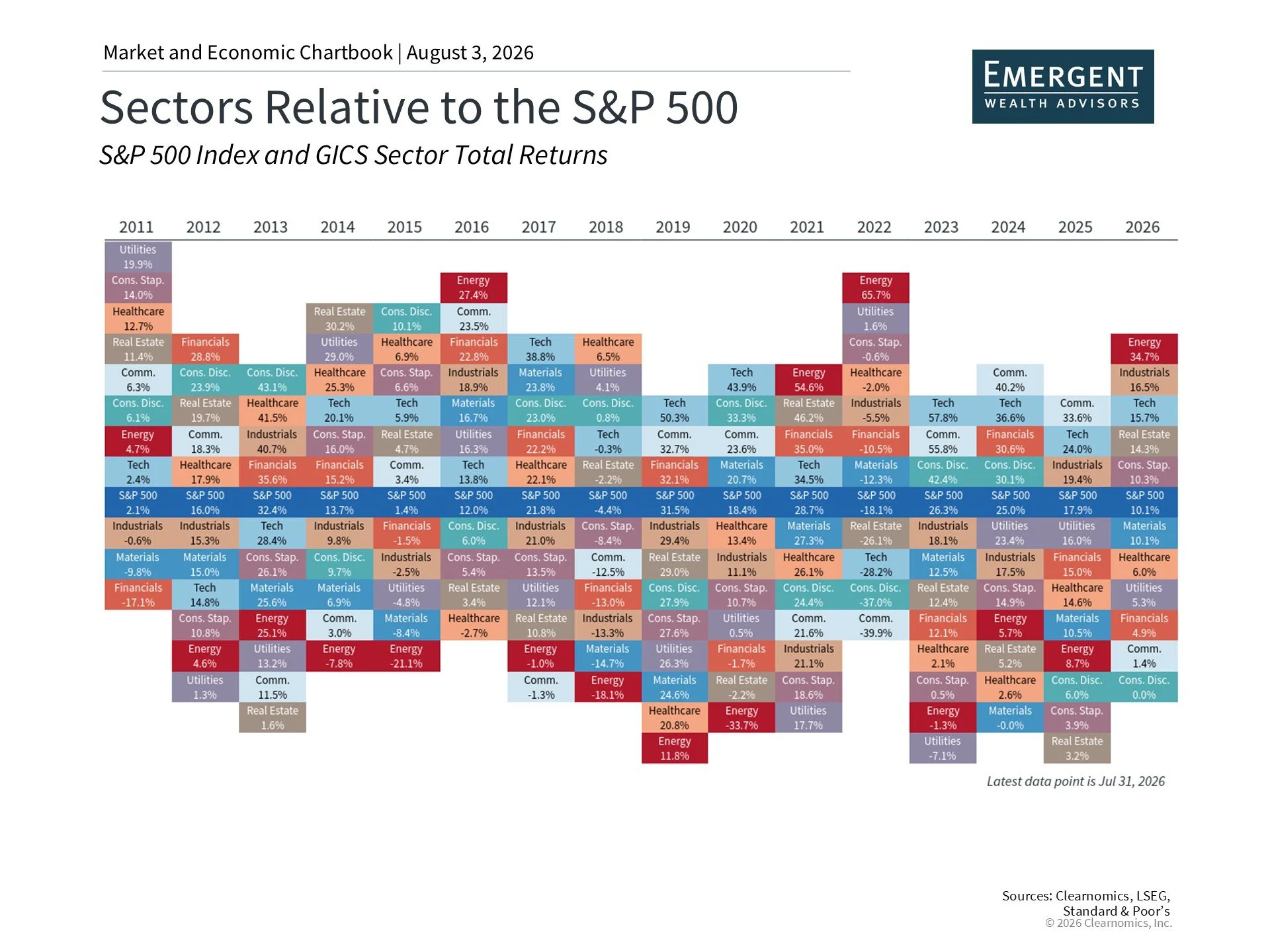
Second quarter corporate earnings reports brought renewed scrutiny to AI-related spending. Market swings were largely driven by investor concerns about the free cash flow of large technology companies, often referred to as “hyperscalers.” These firms continue to pour hundreds of billions of dollars into new data centers and AI infrastructure, and the market is closely watching whether these enormous capital expenditures will ultimately translate into profits. Notably, spending on data centers alone has grown to become a meaningful contributor to U.S. economic activity, surpassing all other categories of office construction.
Concerns about the scale of this investment also stirred volatility in international markets, particularly among global semiconductor companies. Major chip suppliers experienced sharp pullbacks during the month, contributing to a 24% decline in South Korea's KOSPI 200 index in July, following a significant run-up in 2025. This illustrates that while AI remains a powerful market theme, it also introduces periods of notable volatility.
Another significant AI development in July was the release of a new large language model, Kimi K3, by the Chinese company Moonshot AI.
This model reportedly competes with the most advanced models from companies such as OpenAI, Anthropic, and Alphabet. It is also “open weight,” meaning that anyone with the right hardware can run the model themselves, in contrast to most frontier models which are proprietary.
While last year's DeepSeek models demonstrated that AI models could be developed more efficiently, Kimi K3 shows that newer open models can be competitive with cutting-edge ones. This introduces further uncertainty about the trajectory of the AI industry, both in terms of hardware and infrastructure requirements, and regarding which country will lead the next phase of AI development.
In addition, Fitch, the credit rating agency, flagged what it described as “major credit risk” across the AI ecosystem. Their report cited slowing consumer momentum and the highly interconnected nature of financing and supply arrangements among major players.
For long-term investors, it is worth remembering that AI is just one of many forces influencing markets. The chart above illustrates that other sectors, including Energy, Industrials, and others, have also performed well this year. As markets continue to assess the long-term economic impact of AI, maintaining balance across sectors and asset classes remains a sound approach.
Middle East conflict briefly pushes oil back above $100
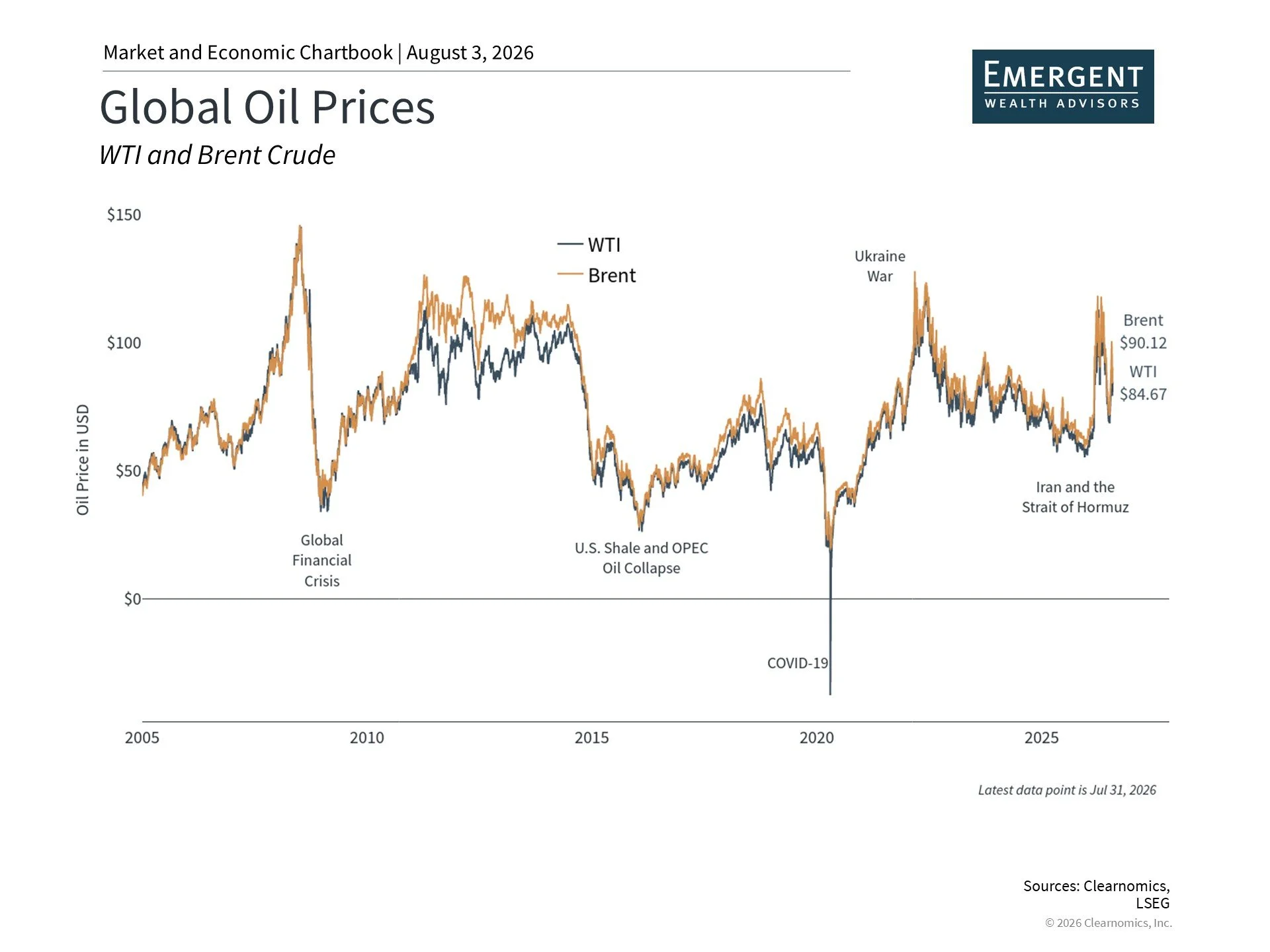
The ongoing conflict in Iran also contributed to short-term market turbulence. Tensions escalated mid-month when the U.S. carried out additional airstrikes against Iranian military sites, resulting in slower traffic through the Strait of Hormuz, a critical chokepoint for global oil supply. The conflict broadened further when Yemen's Houthi forces struck Saudi Arabian oil tankers in the Bab al-Mandeb Strait in the Red Sea.
In response, Brent crude briefly surpassed $100 per barrel before retreating to approximately $90 by month-end. For context, oil had fallen as low as $72 per barrel in early July. Elevated energy prices carry broad economic implications, as they directly increase fuel costs for households and businesses. Gasoline prices remain near $4.10 per gallon nationally, a level that could keep headline inflation elevated.
Federal Reserve holds rates steady amid committee disagreement
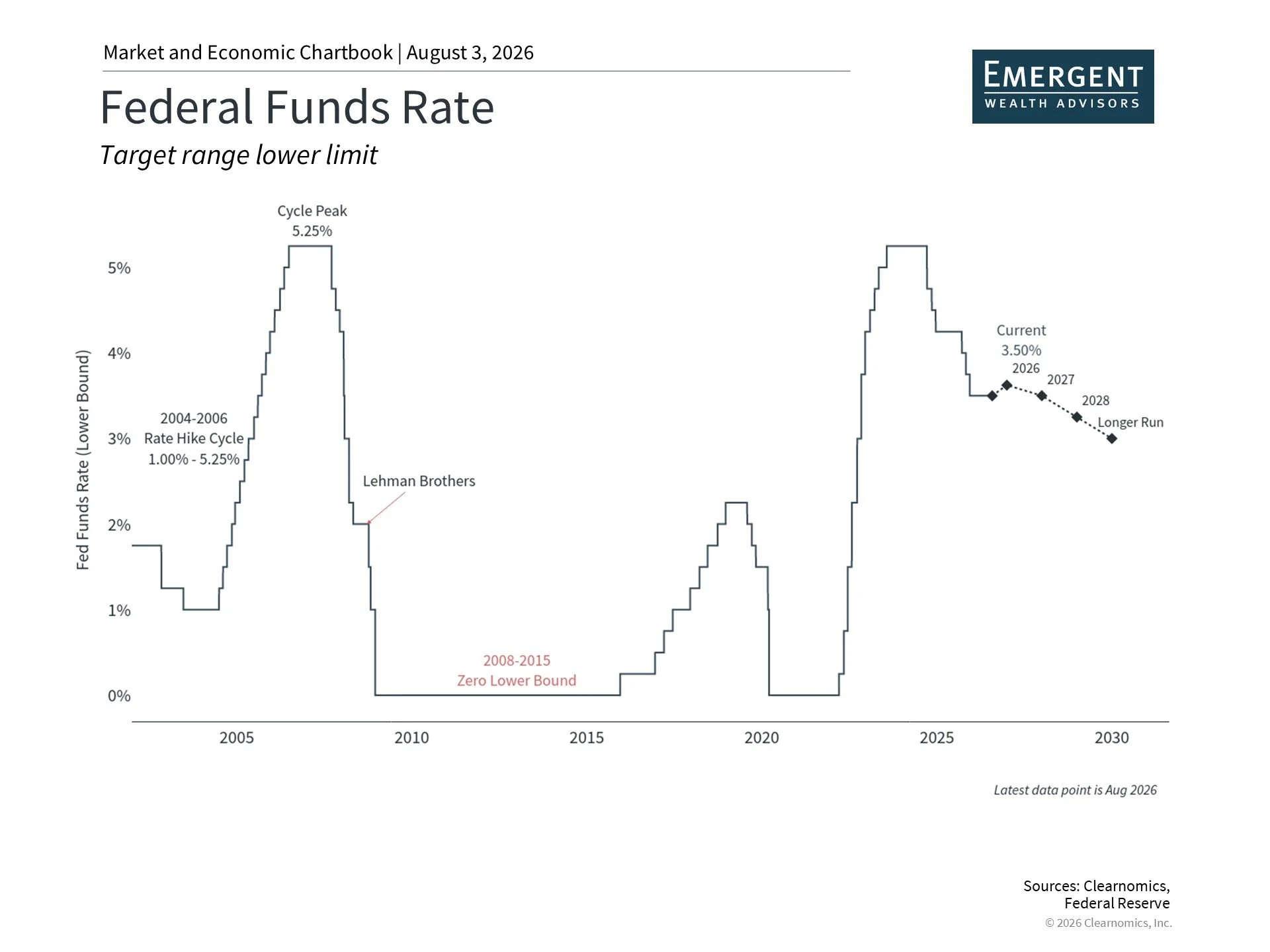
At its July meeting, the Federal Open Market Committee (FOMC) left the federal funds rate unchanged in a range of 3.50% to 3.75%, even as concerns about higher inflation persisted.
The decision added to market volatility, with bond yields rising as investors tried to anticipate the Fed's next steps.
New Fed Chair Kevin Warsh has deliberately scaled back communication about the Fed's likely future actions. The FOMC statement has become considerably shorter, and he has avoided questions about how the Fed might respond to various economic scenarios. This reduced “forward guidance” means investors may be less certain about how the Fed will react to higher inflation, a weakening labor market, or other developments.
The immediate market reaction was a rise in bond yields, with both nominal and real Treasury rates climbing to their highest levels in recent years. Market-based expectations now suggest the Fed could raise rates once by October and possibly twice by mid-2027.
Notably, three Fed officials dissented at the latest meeting, meaning they preferred a rate increase. This degree of internal disagreement has been rare in recent years, with the last comparable dissent occurring in September 2016. For markets, these dissents offer a window into what the Fed may be deliberating at upcoming meetings, particularly if inflation remains elevated.
For investors, uncertainty around Fed policy could translate into greater volatility in yields. At the same time, higher yields can present opportunities for portfolio diversification.
New tariffs add more economic uncertainty
New tariffs introduced additional complexity to the economic backdrop in July. After the Supreme Court ruled that last year's reciprocal tariffs under the International Emergency Economic Powers Act were illegal, the administration responded by implementing new tariffs under a different trade law, Section 122 of the Trade Act of 1974. Those tariffs expired in July, prompting the White House to roll out additional new tariffs under separate trade rules.
The net result is that many countries now face tariffs in the range of 10% to 12.5%. Certain countries face considerably higher rates, including a 50% tariff on select Canadian goods such as cement, dairy, and alcohol. These measures were implemented under Section 338 of the Tariff Act of 1930, with the administration citing what it described as discriminatory treatment of American products.
As with previous rounds of tariffs, the full economic effects will take time to become apparent. A key point for long-term investors is that many of the market and economic concerns tied to tariffs have not materialized to the extent some had anticipated. While tariffs do affect specific industries and consumer prices, companies have the ability to adapt and adjust their pricing strategies over time. The economy has continued to expand steadily, and the S&P 500 has reached numerous new all-time highs over the past year.
The bottom line? July reinforced the importance of keeping a long-term perspective. Market challenges can create opportunities for investors who are positioned across different asset classes. Staying focused on the bigger picture, rather than reacting to the news headlines, remains the best way to achieve financial goals.