

The ongoing conflict in Iran and the effective closure of the Strait of Hormuz have driven oil prices sharply upward. Both Brent crude and WTI have surged from roughly $70 per barrel to approximately $100 in just a matter of days, approaching levels last seen when Russia invaded Ukraine in 2022. This has generated considerable uncertainty across global financial markets, with discussions around a "global economic downturn" and "stagflation" becoming more prominent.
For investors, history consistently suggests that maintaining a long-term perspective is the most effective approach during periods of heightened uncertainty. Energy price shocks have recurred roughly every decade, and while each episode is distinct, a recognizable pattern emerges: oil prices spike in response to geopolitical conflict, markets experience volatility, and conditions eventually stabilize and recover. What key considerations should investors keep in mind in the weeks ahead?
Why oil has climbed to $100
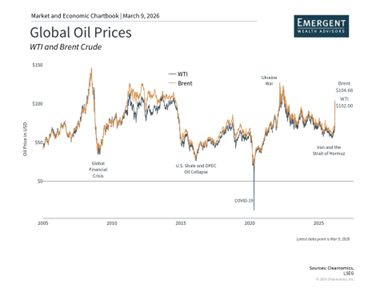
Oil prices reflect supply disruptions at a critical chokepoint
The Strait of Hormuz, a narrow waterway connecting the Persian Gulf to global markets, sits at the center of the current oil price surge. Approximately 20% of global oil shipments and a substantial share of natural gas transit this chokepoint annually. Attacks on tankers and safety concerns have effectively halted traffic, with major shipping companies suspending bookings and hundreds of oil tankers at a standstill inside the strait.
This disruption has created a domino effect. With tanker transportation blocked, major Middle East producers—including Saudi Arabia, Iraq, Kuwait, Qatar, and the UAE—have been forced to store excess oil, and as storage capacity fills, production cuts have followed. Unlike typical OPEC cuts aimed at boosting prices, these measures are involuntary. When Russia invaded Ukraine in early 2022, Brent crude surged to nearly $128 per barrel before eventually settling as supply and demand adjusted—a reminder that even sharp price moves tend to normalize over time.
How higher oil prices affect consumers and businesses
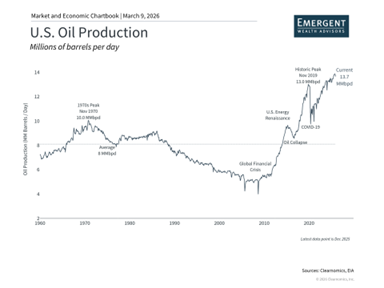
Higher oil prices ripple through the broader economy in both direct and indirect ways. For consumers, the most immediate impact is felt at the gasoline pump, where prices have risen toward $3.50 per gallon—notably still well below the $5 per gallon level experienced four years ago. Beyond gasoline, rising energy costs increase the expense of transporting goods, manufacturing products, and powering businesses, effectively raising the cost of all goods and services and compressing household budgets.
Economists describe this dynamic as "cost-push inflation," which is fundamentally different from demand-driven inflation. Supply-driven price increases are often viewed as "transitory," meaning their effects tend to fade as conditions stabilize or the economy adapts. Importantly, the U.S. is better positioned today than during prior oil crises, given its role as the world’s largest producer of oil and natural gas—providing a degree of energy independence that helps cushion the domestic economy relative to peers in Asia and Europe.
Markets can weather higher oil prices
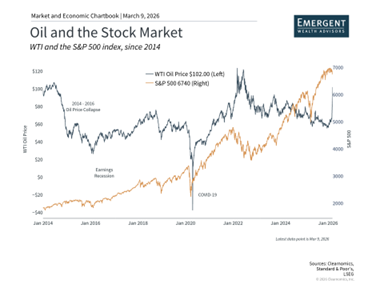
While short-term market reactions to oil price shocks are common, it is important to maintain broader perspective. The energy sector has gained approximately 25% year-to-date, leading the market just as it did in 2021 and 2022, while commodities have risen over 20%, supported by both energy and precious metals. This highlights the value of holding diversified portfolios across asset classes and sectors, which can help cushion the impact of concentrated volatility.
The path of monetary policy also warrants attention. If inflation rises due to elevated oil prices, the Fed may need to hold rates higher than currently anticipated. Market-based expectations currently point to at least one rate cut this year in September, with the possibility of a second by year-end. However, if the supply disruption proves temporary, its influence on monetary policy may ultimately be limited, consistent with historical precedent.
The bottom line? While the conflict in Iran has pushed oil prices above $100 and created volatility, financial markets and the economy have historically adapted to supply shocks. Investors should maintain perspective, stay diversified, and continue to focus on their long-term financial goals rather than reacting to daily geopolitical headlines.