

As widely reported in the news, the U.S. and Israel have conducted military strikes against Iran, targeting its leadership, military infrastructure, and nuclear facilities. Iran's Supreme Leader has been confirmed killed, and Iran has responded with missile and drone attacks throughout the Middle East. President Trump has indicated that the objective of the operation, known as "Operation Epic Fury," is regime change in Tehran, with strikes anticipated to continue for several weeks and a number of U.S. troop casualties already reported.
The situation continues to develop rapidly, and the safety of civilians in the region and U.S. troops remains the foremost concern. Setting aside the gravity of these events, investors naturally have questions about what this means for markets, energy prices, and their portfolios.
President Dwight D. Eisenhower once remarked that "plans are worthless, but planning is everything." Applied to the current situation, this suggests that while specific geopolitical events are impossible to predict, their occurrence over time is not surprising. Building a well-structured portfolio and a sound financial plan is designed precisely to address this kind of uncertainty. Although every geopolitical event has its own unique characteristics, financial markets have successfully navigated countless wars, crises, and regional conflicts, including the U.S. operation in Venezuela earlier this year.
The essential challenge for long-term investors is to distinguish between geopolitical headlines and portfolio decisions. What should investors bear in mind as events continue to unfold in the weeks ahead?
The current strikes are the latest development in a long-running conflict
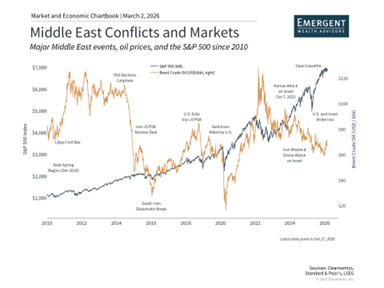
Although the scale of the current military action is considerable, tensions among the U.S., Israel, and Iran have been building for some time. This most recent escalation follows a monthlong U.S. military buildup in the region, failed negotiations over Iran’s nuclear program, and President Trump’s earlier pledge to support Iranian protesters who opposed the regime.
To understand how events reached this point, it is helpful to review the broader timeline:
• Tensions between Iran and the West span several decades, rooted in the Iranian regime’s longstanding backing of Hezbollah and Hamas, both of which have been central to conflicts throughout the Middle East.
• In 2019, Iran carried out drone strikes on Saudi Arabia’s oil infrastructure, temporarily disrupting global oil production and stoking fears of a broader regional conflict.
• Hamas’s October 2023 attack on Israel reignited regional hostilities, eventually drawing in Hezbollah and heightening tensions with Iran.
• Last summer, Israel conducted a 12-day military campaign against Iran, targeting nuclear and ballistic missile programs in the most direct confrontation between the two countries in decades.
• Earlier this year, Iranian protesters challenged the regime, with President Trump pledging U.S. support.
• Negotiations over Iran’s nuclear program broke down without an agreement. In the weeks that followed, a major U.S. military buildup in the region signaled that a larger operation was being planned, ultimately leading to the current strikes.
The scope of the latest strikes, including the targeting of Iran’s senior leadership, is broader than previous engagements. Nonetheless, history also illustrates that geopolitical conflicts are not always a catalyst for sustained market movements.
Energy markets and the Strait of Hormuz
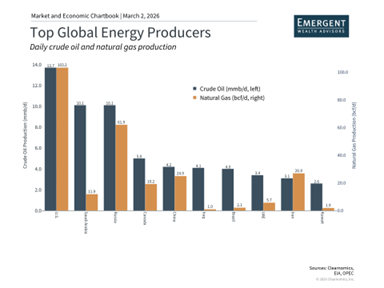
For investors, the most direct channel through which Middle East conflicts affect financial markets is global energy prices. Iran is an OPEC member and produces approximately 3 million barrels of oil per day and 27 billion cubic feet of natural gas per day. The country also borders the Strait of Hormuz, the world’s most strategically important energy corridor. According to the U.S. Energy Information Administration, roughly one-third of all seaborne oil exports and one-fifth of global natural gas pass through this waterway. Even the prospect of a disruption to this critical passage could have meaningful implications for global energy markets.
Oil prices had already been climbing in anticipation of the strikes. The immediate market reaction pushed prices higher still, with WTI rising to the low $70s and Brent crude reaching just under $80 per barrel. While Western nations do not directly import Iranian oil, the global and fungible nature of the oil market means that any supply disruption can push prices higher across the board.
Some context is worth keeping in mind, however. Current oil prices remain well below the 2022 peak of nearly $128 per barrel reached when Russia invaded Ukraine. Conditions today are notably different. In 2018, the U.S. became the world’s largest producer of oil and natural gas, with domestic output now surpassing that of other major producers such as Saudi Arabia and Russia. While the U.S. continues to participate in global energy markets, this production capacity helps shield the domestic economy from supply disruptions.
It is also worth noting that oil prices are notoriously difficult to predict. Following Russia’s invasion of Ukraine, many analysts expected prices to remain elevated for an extended period. Instead, prices stabilized and declined much sooner than anticipated. Similarly, the U.S. operation in Venezuela in January of this year caused a brief movement in oil prices but had little lasting impact.
Maintaining investment discipline during geopolitical uncertainty
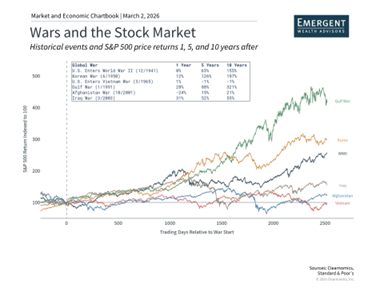
For long-term investors, the most enduring lesson from past geopolitical conflicts is the importance of remaining invested. It is entirely natural to feel apprehensive when news reports describe military strikes, retaliatory attacks, and the possibility of a wider regional war. These events carry real human consequences and stand apart from the typical flow of market commentary on earnings, valuations, and economic data.
The accompanying chart illustrates that markets have managed to navigate even the most serious global events. From World War II to the Gulf War to the conflicts in Iraq and Afghanistan, markets experienced short-term volatility but were ultimately guided by economic fundamentals over the long run. More recently, the Russia-Ukraine conflict and the Israel-Hamas war introduced considerable uncertainty but did not fundamentally alter the broader market trajectory.
It is also worth noting that Iran represents minimal direct exposure in most investment portfolios. The country has been subject to extensive sanctions for years, its economy has experienced severe hyperinflation, and its currency, the Rial, has collapsed in value. As a result, very few investors hold any meaningful direct exposure to Iran within their asset allocations.
Markets may face volatility over the coming days and weeks as the situation evolves. Oil prices could climb further, and heightened uncertainty may weigh on investor sentiment. However, attempting to time these market moves has historically proven counterproductive. Markets have demonstrated a tendency to rebound when least expected, and missing even a handful of the best trading days can meaningfully reduce long-term returns.
The bottom line? The U.S. and Israeli strikes on Iran represent an important geopolitical development. However, history shows that investors who maintain diversified portfolios aligned with their long-term financial goals are best positioned to navigate periods of uncertainty.